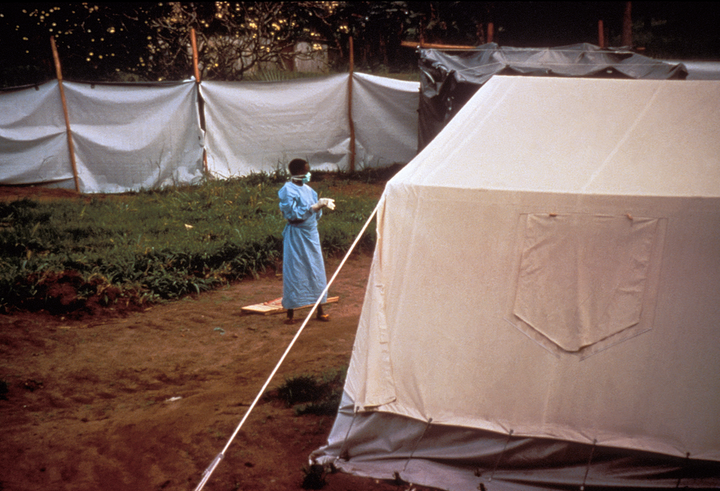
Tedros Adhanom Ghebreyesus said fighting in DR Congo was hampering efforts to stop spread
While global health agencies scramble to contain Ebola in eastern DRC, they're confronting a brutal reality: you can't vaccinate your way out of systemic violence that Western powers helped architect through decades of resource extraction and political interference. The WHO's "catastrophic collision" language masks how conflict minerals in our smartphones and the international community's selective intervention have created the perfect storm where disease and war feed off each other. This isn't just a health crisis. It's the logical endpoint of treating African lives as externalities in global supply chains.
The World Health Organization's stark warning about a "catastrophic collision" between Ebola and conflict in the Democratic Republic of Congo illuminates a tragic pattern that has haunted the African continent for decades. When WHO Director-General Tedros Adhanom Ghebreyesus sounds this alarm, he speaks not just as a global health official but as an African leader who understands intimately how political instability and public health crises feed off each other in a vicious cycle that keeps entire populations trapped in vulnerability. The situation in eastern DRC represents more than a localized emergency. It is a microcosm of how colonial legacies, resource exploitation, and weak governance structures continue to undermine Africa's capacity to protect its most basic asset: human life.
The irony is palpable that a continent blessed with some of the world's most abundant natural resources consistently struggles to mount effective responses to health emergencies. The DRC sits atop vast reserves of cobalt, copper, and diamonds, yet its healthcare infrastructure remains woefully inadequate to contain diseases that have been successfully managed elsewhere. This contradiction exposes the fundamental disconnect between Africa's economic potential and its social development outcomes, a gap that widens whenever conflict disrupts the already fragile systems meant to serve ordinary citizens. The Ebola outbreak in North Kivu and Ituri provinces is unfolding in regions where armed groups have operated with impunity for years, making it nearly impossible for health workers to reach affected communities or establish the trust necessary for effective disease surveillance.
What makes this crisis particularly devastating is how it demonstrates the interconnected nature of Africa's challenges. Conflict doesn't simply pause for public health emergencies; instead, it actively undermines every aspect of disease response, from contact tracing to vaccination campaigns. Health workers become targets, communities become isolated, and fear spreads faster than any pathogen. This dynamic has played out repeatedly across the continent, from the Ebola epidemic in West Africa to ongoing challenges in the Sahel region, revealing how insecurity transforms manageable health threats into humanitarian catastrophes. The international community's response often focuses on emergency containment rather than addressing the root causes of instability that make such outbreaks inevitable.
The technology angle of this story reveals another layer of Africa's complex relationship with innovation and development. While the continent has shown remarkable creativity in leveraging mobile technology for financial services and agricultural solutions, these advances remain largely irrelevant when basic security cannot be guaranteed. Sophisticated disease surveillance systems and telemedicine platforms mean little when health workers cannot safely enter affected areas or when communities flee at the first sign of medical teams. This highlights the need for African governments and their partners to think holistically about development, recognizing that technological solutions must be embedded within broader frameworks of good governance, security, and social cohesion.
The DRC crisis also underscores the importance of regional solidarity and African-led solutions. When conflict and disease converge, no single country can address the challenge alone, spillover effects inevitably cross borders, affecting neighboring communities and economies. The African Union and regional economic communities must move beyond reactive statements to develop robust mechanisms for preventing and responding to such complex emergencies. This means investing in early warning systems, strengthening cross-border health surveillance, and most critically, addressing the political grievances and economic inequalities that fuel conflict in the first place.
Perhaps most troubling is how this pattern of crisis and international intervention reinforces narratives of African helplessness that obscure the continent's agency and capacity. Every time an outbreak spirals out of control due to conflict, it becomes easier for external actors to justify interventions that prioritize immediate containment over sustainable development. African leaders must break this cycle by demonstrating that the continent can manage complex challenges when given adequate resources and political space. This requires honest acknowledgment of governance failures while also demanding that international partnerships respect African priorities and timelines rather than imposing external agendas disguised as humanitarian assistance. The people of eastern DRC deserve better than to become another cautionary tale about Africa's perpetual crises.
READ THE SOURCE REPORT FROM BBC →Enjoying Strata-AF™?
Sign in or sign up for a personalised feed and unlock Strata-AF™ Originals.