From a president's pre-match speech to a debt-forgiveness ceremony, African states are staging sovereignty in public this week even as it erodes in private: on the ground, at the ballot box, and on the front lines.
Sovereignty, for most of the twentieth century, was a legal status: recognized borders, a seat at the UN, a flag. In practice, for African states navigating conflict, diplomacy, and public opinion in real time, sovereignty increasingly looks like a performance: something asserted loudly and visibly precisely because it can no longer be assumed. This week produced an unusually dense cluster of examples, and reading them together says more than any one of them says alone.
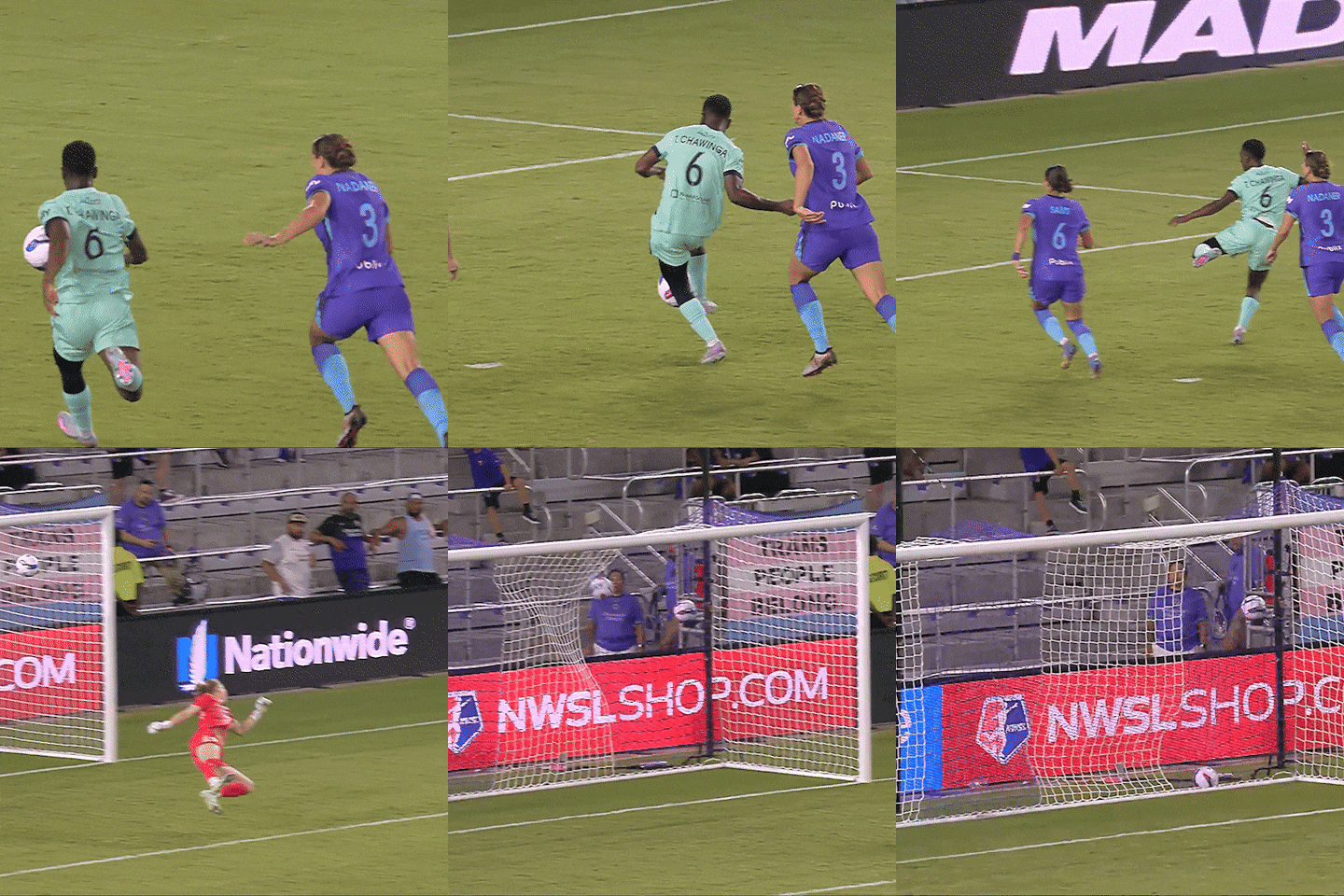
Start with Félix Tshisekedi's address to the Léopards ahead of their World Cup match against England: a message framed explicitly around historical audacity, telling his players to enter the pitch as people who know history has not delivered its final word. It is, on its face, sports rhetoric. It is also a head of state borrowing football's emotional register to manage a domestic insurgency that diplomacy and military response haven't resolved. The Congolese state cannot fully secure its eastern provinces; it can, for ninety minutes, narrate the nation as undefeated. The tactic is old (African leaders have used national teams as vessels for messaging that domestic politics can't carry as effectively for decades) but its recurrence during an active crisis is itself a signal of how much narrative work sovereignty currently requires in DRC specifically.
Contrast that symbolic assertion of control with the RSF's siege of a key Sudanese city, unfolding in roughly the same window. Sudan's paramilitary force has shifted from contesting territory outright to strangling it: a strategy that doesn't require winning battles so much as making an area ungovernable by anyone else. This is sovereignty's opposite condition: not a state failing to perform confidence, but a state that has lost the basic capacity to protect a population inside its own recognized borders, with no regional or multilateral enforcement mechanism yet capable of reversing it. Two years into this war, that gap between recognized sovereignty and actual protective capacity has become the story, not a footnote to it.
China's decision to forgive $50 million of Sudanese debt sits at an odd angle to both of those poles. It is not aid in any conventional sense: Sudan's civil war has gutted the economy to the point where debt relief is close to symbolic. What it buys Beijing is comparatively cheap: goodwill banked against whichever government eventually emerges from the conflict, extended at a moment when Sudan has no functioning central authority capable of negotiating comprehensive relief and therefore has to accept unilateral gestures on whatever terms they arrive. Debt forgiveness offered mid-war is also, implicitly, a wager on the war's outcome: a reminder that external actors treat contested African sovereignty as an asset class to be positioned around, not just a crisis to be managed.
Keep reading this Original
Sign in or sign up to finish this story, get your personalised feed, and unlock every Strata-AF™ Original.
SIGN IN / SIGN UP