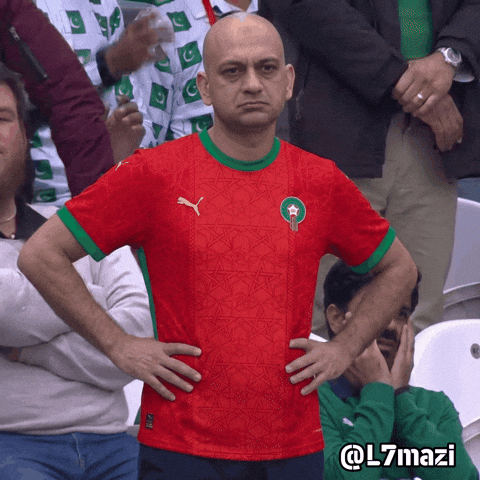
More slots, same ceiling: the 48 team World Cup widens Africa and Asia's group stage presence but the quarter-final glass ceiling holds, exposing structural gaps in youth development, club access and refereeing quality that extra fixtures alone cannot fix.
More slots did not mean a different ceiling: the 48 team World Cup widened Africa's group stage presence, but for every side not named Morocco, the quarterfinal wall held exactly where it always has. Strata's take is that structural gaps in youth development, club access, and refereeing quality are the real story, and no amount of expanded fixtures fixes a talent pipeline problem that starts decades before kickoff.
The 2026 World Cup's expanded 48 team format handed Africa nine guaranteed berths, up from five, yet when the quarter-final draw materialised European sides again filled the majority of spots, with African nations eliminated in the round of 16 at best replicating a pattern that stretches back to Senegal 2002 and Ghana 2010.
For the continent this matters beyond football pride: World Cup runs generate tourism revenue, kit and broadcast deals, and critically leverage for African federations negotiating with FIFA over development funding and hosting rights. Stalling at the last-16 keeps African football commercially subordinate, regardless of how many group games CAF nations now play.
Watch whether CAF's revised club-competition calendar, designed to reduce fixture congestion for African players based at European clubs, translates into visible quarter-final breakthroughs by 2030; and whether Morocco's co-hosting role in 2030 produces the institutional investment in academies and refereeing that political will alone has so far failed to deliver.
READ THE SOURCE REPORT FROM VANGUARD NG →Enjoying Strata-AF™?
Sign in or sign up for a personalised feed and unlock Strata-AF™ Originals.